Tony Danza–Nakiya relationship
I'd Like to Apologize to Every Teacher I Ever HadThe Tony Danza–Nakiya relationship is one of the clearest examples of how Danza’s connection with a student develops through attention, shared activity, and a growing willingness to learn from one another. Nakiya first meets his nervous efforts to establish a classroom with a grin and silence; soon she is volunteering, performing, helping organize a school event, and teasing him with the familiarity of someone who can also tell him when he is getting it wrong. Their closeness is not presented as a single dramatic turning point, but as a year-long accumulation of small gestures and reciprocal trust.
First Encounter and Classroom Connection
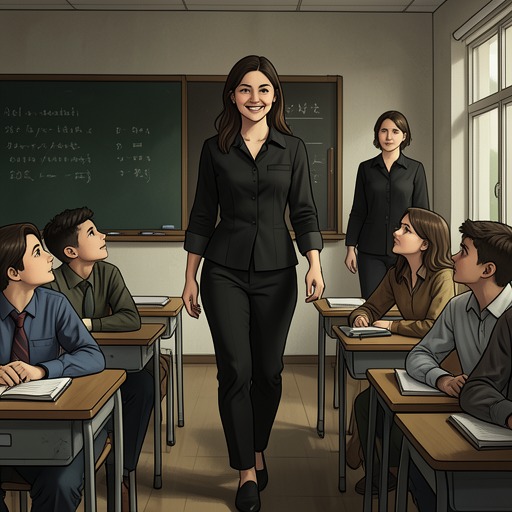
On Danza’s first day, the school corridors are noisy, but his classroom is unexpectedly quiet. Nakiya is the first student to enter: small and neatly dressed in jeans, a white T-shirt, and a plastic headband, she bounces lightly on her feet and smiles without speaking. When Danza asks her name, she shakes his offered hand in a way that makes him realize he has already mishandled the pronunciation. He repeats it to himself, but decides to call her Nicky. The moment establishes both his desire to make a personal connection and the gap between that intention and the attentiveness a student actually deserves.
As Danza struggles to hold the class’s attention, he asks the students to introduce themselves and chooses Nicky to go first. She is the only one who does not seem eager to disappear, so he makes her his first point of contact with the group. At the front of the room, she introduces herself as Nakiya, says she plays basketball and lacrosse, and mentions that she plays drums in the school band and at church. She also says that she likes to smile, then beams at the class. Danza’s immediate affection for her is unmistakable, but the scene also gives her an identity beyond being the student who makes him feel welcome: she arrives with interests, confidence, and a willingness to take the first step.
That early connection takes shape within the larger school community. Danza describes teaching in Philadelphia as learning the mantra of “we,” and Nakiya’s readiness to step forward gives that idea a concrete form in his classroom. She is not simply an audience for his attempt to become a teacher; she helps make participation possible when the class is reluctant. Their bond begins with Danza noticing her, but it quickly depends on her own initiative.
Learning to Share the Work
Their relationship becomes especially visible when Danza takes students on a field trip to Washington, D.C. Nakiya sits next to him on the bus as the group recognizes buildings they have encountered in books. Danza tells her about visiting the city with his Boy Scout troop at thirteen and winning a race to the top of the Washington Monument, back when visitors could climb the stairs. He recalls that “Can’t Get Used to Losing You” was playing on the radio that day. Nakiya responds with an amused acknowledgment of how specifically he remembers the past. The exchange lets Danza share a piece of his own history, while her response gently turns his storytelling into a moment of connection between teacher and student.
The trip also gives their relationship a shared academic setting. At the National Archives, students divide into teams to research different groups of records. Nakiya narrates a video of the class at work, made with classmates and saved on DVD for them to take back to school. The activity draws on her willingness to speak and places her in a public role: she helps document the students’ own engagement rather than merely receiving Danza’s lesson. When the group is ready to begin, he has to manage his surprise at how involved they are and call them to the work. Their exchange of roles is modest but important: the teacher creates the occasion, and the students—including Nakiya—give it energy and shape.
Danza also brings songs and questions about social justice into his teaching. He uses a song to connect making opportunities for oneself with working toward a more just society. Nakiya takes up the subject in her own way, making “What you know about social justice?” one of her familiar greetings to him, alongside “Hey, you know Sal?” The phrase turns a lesson into part of their everyday conversation. It shows how classroom material can travel beyond the formal lesson without ceasing to be playful: Nakiya repeats the idea as a greeting, and Danza recognizes it as part of their shared language.
Collaboration, Limits, and Humor
When Danza helps organize a staff talent show, he recruits Nakiya and Katerina to make and distribute flyers, and asks Nakiya to serve as master of ceremonies. He scripts introductions for her on cards and works with her in the wings to devise jokes and asides that can bridge acts, entertain the audience, and put nervous teachers at ease. The role extends the trust established in the classroom: Danza gives Nakiya responsibility in front of the school, while she brings performance ability and practical judgment to a project he is trying to make succeed.
That responsibility has limits, and the show makes them visible. When a math teacher and his partner continue singing through “My Way,” Danza wants Nakiya to go onstage and cut the performance short. She refuses. Her reason is not stage fright or indifference: she says that the teacher gives her math and that she cannot risk her grade. The episode punctures the easy idea that an enthusiastic student will always do whatever a teacher asks. Nakiya can be warm and committed to the event while still protecting her own interests within the school’s power structure.
She also contributes solutions on her own terms. When Voltron is about to perform and its music fails, the audience becomes restless. Nakiya suggests that Danza cover the delay with his ukulele. Her suggestion helps move the show forward and demonstrates that the collaboration is not merely an adult assigning tasks to a student. Nakiya sees a problem and proposes a workable response. Later, she lines performers across the stage and raises her hand over each one as the audience votes by applause. The event draws seven hundred students, and Danza reflects that young people like seeing teachers do something different. Nakiya’s role—part organizer, part host, part improviser—helps make that difference possible.
Mutual Influence and a Continuing Bond
Their familiarity includes teasing as well as encouragement. During a moment when Danza is upset, a student tells him he is a crybaby, and Nakiya joins in; soon the whole class is chanting the phrase. The teasing is public and affectionate in tone, but it also shows that the teacher is no longer protected from the students’ judgments by his adult role. Nakiya can participate in the joke because their connection has room for informality, and Danza records the class chorus rather than treating the moment only as a breach of authority.
She is equally direct when Danza needs to be tougher. When Nakiya and Tammy come to help him, Nakiya explains that firmness matters not only for students who are already considered difficult but also for students who behave well. Her advice broadens the purpose of classroom authority: consistency is something the whole class observes, not a tool reserved for disciplining particular students. The student who had once helped him begin a hesitant class now helps him interpret what the rest of the students need from him.
Near the end of the year, Nakiya is the last student to leave after a test. She gives Danza two thumbs-up and tells him, “See you tomorrow, Mr. Danza. Nice test.” He sits down to work as soon as she is gone. The small exchange combines a student’s assessment of his teaching with the ordinary promise of another day together. On another occasion, Nakiya writes “Make the best of a baaaad situation,” echoing a phrase that becomes part of the book’s recurring language about making the most of difficult circumstances. Their relationship is thus carried not only by large shared activities but by brief words that travel between classroom, conversation, and memory.
Danza’s broader reflections make the limits and stakes of such closeness visible. After the television show ends, he and his wife separate, and he worries about missing time with his daughter while trying to give his students his attention. He cannot read his daughter’s reassurance that it is all right for him to remain away, and later admits to Lynn Dixon that he is unsure whether he wants to care so intensely about anything again. These concerns do not make Nakiya responsible for resolving his private life; rather, they place the student-teacher bond within a year in which care is both meaningful and emotionally demanding. Nakiya’s humor, initiative, and candid guidance show what Danza gains from caring, even as his uncertainty reveals its cost. The relationship’s significance lies in that reciprocity: he tries to engage and support her, while she repeatedly helps him understand the classroom and the work of being her teacher.